Sunday, April 27, 2014

Sparky Bass & Portlandia

One of the things I love about building/making/creating is that, even if I have a goal for the project, I never really know how a project will come out until it's done. It's all the happy accidents that occour during creation, and the decisions made as they present themselves, that make the journeys so enjoyable for me (and the projects usually end up - suprisingly - different yet better than I could have imagined). My latest bass project is named Sparky after my grumpy old chihuahua Sparky...
...and a sparkly gold bass I saw at Guitar Center Hollywood back in 2013.

This Fender Custom Shop Early Relic '60s Jazz Bass stopped me in my tracks, with a body color I would have not previously thought of as attractive. But as I have gotten deeper and deeper into classic 50s and 60s bass guitar looks and finishes (and the whole 50s-60s era design in general) this bowling-ball sparkle gold paint stikes me now as thouroughly cool and classic, even if in a slighly ironic/kitchy way. It played OK, but the just under $3000 price tag was never is the cards or the bank account. I took some photos and filed it away in my head for future possibilities. A year earlier I purchased a gold-top Casady Bass, and a couple of months ago I also aquired a gorgeous gold-top Epiphone Les Paul guitar, so the finish was and remains on my radar.

In my January 2014 blog entry I wrote about completing my first full-on attempt at relic'ing with the black P-Bass. I took it on a couple of gigs, but like most lighter-weight P-Basses I have owned, the very bottom string tone seems to be missing something. Wood can be such a crapshoot; the body wood has to have sufficient mass PLUS be resonant, and sometimes there even seems to be a magic combination of neck and body. I have also recently come to the conclusion that lighter bodies are OK for Jazz Basses (see my Pepito Jazz Bass), but the Precision tone screams of body mass, especially on the E string. As much as I worked on the black P-Bass and LOVED the look, I knew this body was not going to cut it for me. So I watched eBay and found a seller with a black Ash Fender Squire P-Bass body with hardware and pickups that weighed 7lbs, which I bid on and won for under $60.

After spending some/time researching gold sparkle spray paint, I setted on cabs of Rust-oleum Gold Glitter paint at Home Depot. I figured it might cause some finish issues (it's actual gold glitter suspended in a paint base) but it COULD look awesome, so I sanded off as much of the black finish as I could.

Once stripped and sanded, I primed and started applying the coats. For the first base coat I tried using up a can of metallic spray paint I had lying around for years, only to realize after starting to spray that it was silver, not gold. I would love to take credit for this genius way to have the silvery color showing thru certain sanded areas to look more "worn," which it now does, but it was just another in a series of happy accidents.

The gold glitter paint really isn't "paint" as much as a delivery vehicle for gold glitter in a clear base. It goes on rather thick, but looks phenomenal, just like my memory of muscle car finishes and classic bowling balls. I had no idea at the time how it would take to cracking/relic'ing or even sanding, but I guess we will find out. 
Attempts at cracking, using upside down compressed air to freeze the finish, were mostly a disaster, although it might be because this finish takes forever to cure (a month later it was still getting pushed around a bit by hardware screwed into it, like golden fudge). 
All I really succeeded in doing was create lots of bubbling in the finish, which I had to sand out and repaint. 
After four cans of glitter, I sanded the finish as smoothly as I could, with some deliberate - and some not so deliberate - sanding thru to reveal the silver undercoat. This will turn out to look great, especially on the top where arm wear is not uncommon.

Next, after about a month of curing, I wet sanded and polished the finished to smooth it out as much as possible. I'm not looking for a flawless shiny new surface here, but given the materials I chose to work with that was going to be a bit tough anyway.
Now back to the relic'd Black P-Bass. The neck, hardware and pickups were all great, so I had no choice but to cannibalize them all. 
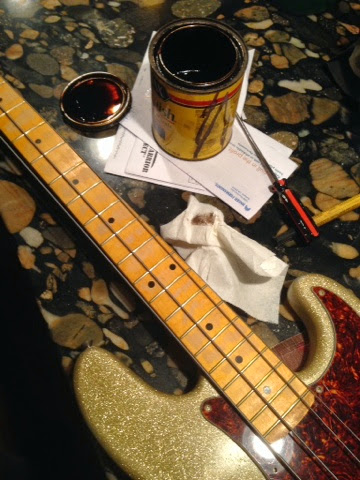
I decided to age the neck a bit more, including using more muriatic acid on the fingerboard to simulate wear of the finish under the strings where the fingers would fret most often, which I then cleaned and stained. While drying I added shielding to the body cavities, then transferred the electronics and hardware.


I had nicely relic'd the gold aluminum pickguard on the black P-Bass, and had planned on using it on this one. But in my shop I found a very nice WD tortoise pickguard that was very similar in tone to the Custom Shop I saw at Guitar Center, and decided to try it instead. It gives it more of a 60s rather than 50s vibe - very Fred Flintstone.

Finally together, it's certainly a looker!
One more tweak: Having burned in and stained the front if this maple fingerboard, I decided it should have a bit deeper color and another clear coat, so I (lazily) removed the strings, taped up the body and headstock, and sprayed it with a bit more amber and clear laquer.
Once dry, I redressed the frets, restrung, and the setup begins again...
I had to readjust the neck height (with shims) and truss rod a few times, then I swapped out the bridge for an older one I had that enabled slightly wider string spacing to line up better with the pickups. The neck, bridge and nut required quite a bit of messing with to get it playing well, but my initial instincts regarding body weight were correct, at least in this case. The heavier body mass did give the bass more presence on the E string. 


So far I have had a chance to play it at one outside gig with LA Zeppelin, and liked the tone more than the feel. I actually found the 70s-era thumb rest location kind if annoying, which is funny because I used to have in that position on every bass I owned 30 years ago. I guess I just got used to resting my thumb on the edge of the pickguard, or ridge of the neck, or even on the edge of a pickup. The taller thumb rest acted as a kind of a stop for my fingers when playing the E string, which felt constricting, so I removed it. I also think even heavier strings might make the strings feel a bit tighter (the looseness if the 45-105 Rotosounds on this bass is making string height and truss rid adjustments tricky), so I might try a set of even heavier roundwounds and see how the feel (I'm sure they will increase the bottom, esp. on the E, but will mess with the nut slots, string height, etc., so another setup is looming). I want a great passive roundwound P-Bass to go with the flatwound sunburst P seen in the header photo on this blog (an incredibly heavy and great feeling AND sounding bass), and this bass is ALMOST there (and was the best looking thing in this recent photo):
Just like my doggie, Sparky the Bass looks a bit worn out, and can be grumpy and difficult, but hopefully (like my doggie) it's worth it.

PORTANDIA

On my birthday weekend in April I had a Journey gig near Portland, OR, a city I have not yet had the pleasure of visiting, unless you count watching Portlandia on TV. For a couple if years I have had an amazing example of "bread porn" on the shelves in my kitchen. It's called FLOUR, WATER, SALT, YEAST by Jen Forkish, the proprietor of Ken's Artisan Bakery in Portland, and I have always wanted to go there and bring back his 3 Kilo Boulle. His baked goods (and the pizza at his pizza place) are every bit as outstanding as advertised, and on our first two trips there I spotted the 3 Kilo Boulle in the racks, and was assured that they had them every day. If course, when we drove back thru Portland on the Sunday morning in order to purchase the boulle and carry it on to the plane, they were sold out! But I did get two 1.5 kilo boules instead, which probably fit better in the overhead bins.
In wandering around Portland we also discovered an amazing chocolate shop call COCAO, with probably the finest cup of drinking chocolate I have ever had, including Florence. It was so rich, and so large, even I could not finish it in one sitting, and carried a third if it around for hours before happily finishing it off the next morning in the hotel.
One memorable and unanticipated chocolate stop in the Portland area was Tilamook Dairy. The wife wanted to check it out for the cheeses (which she did not care for), but I discovered a vegan's worst nightmare: an amazing ice cream called Chocolate Mudslide. I must warn you that this stuff is available at Ralphs and Pavillions in the LA area, and most likely many other places, and a few tubs have found their way into my freezer and mouth since then.
BAD VEGAN! Bad, bad vegan!


Thursday, March 20, 2014

Miscellaneous Chocolates

Tweaking old basses, but no new builds (yet); in the meantime, some new chocolates to report:
Although I am a committed dark chocolate fan, my taste tends to stop at around 80%, where it can start to get rather bitter (I still have a bit of a Tcho 100%, which is essentially inedible). To my surprise I have tried and really liked this Lindt 85%; it's pretty smooth and still just sweet enough. The dark flavor is very substantial, and discourages eating too many squares at a sitting (2 to 4 are quite sufficient).

I have just spent a few days in NYC, and tried to find some legit dark drinking chocolates, which are surprisingly easy to find throughout the city, albiet at a high price. The first one tried, also coming up #1 on Yelp and a couple other websites, was at Mariebelle Fine Chocolates on Broom St. They had a 65% and a 70%; I tried them both and opted for the 70% because it did not contain extra milk, although the ingredients lifted milk in the mix. It was pretty bitter and strong, and I had to add a packet of sugar to help get it down. The buzz did remained for a couple of hours, and I'll have multiple opportunities to adjust the mixture at home with the bag of mix I purchased ($7 for the large hot chocolate, $21 for the mix).


The next day, walking to the subway from The Met Museum, I stumbled upon Maidon du Chocolate. They also had two drinking chocolates, one darker than the other, and I again went with the darkest, which was also very strong, albiet slightly more palatable than the day before (at $9 for the cup). Neither were as thick as Florentine drinking chocolates, but slightly thicker than Berkely's Bittesweet Cafe.

I also found a new chocolate bar, this Cidarella 65% dark with sea salt. A bit thinner than most bars (only 3oz), it turned out to be quite nice. I bit harder than others (but maybe also because it's COLD here) it had a nice dark flavor and a good amour of salt. I even got busted by a Metropolitan Museum of Art docent when I got caught breaking off a piece in a gallery, but what goes better than this while viewing art?

Both NYC drinking chocolates were very serious, adult drinks, but I admit I find West Coast chocolate and chocolate drinks to be not necessarily sweeter, but smoother and a bit more palatable. 

Monday, January 13, 2014

More Relic'ing (aging) on my latest Funster P-Bass

Having completed my most recent Funster bass guitar build (see previous post), I decided to push the relic'ing (cosmetic aging) of the instrument further, including all the hardware, the body and a bit to the neck. Because I have already sanded off the gloss on the body, as well as some of the paint all the way down to the wood, and gave the neck an aged, vintage nitro tint, I thought the hardward looked a bit too pretty. I searched online for ways to age the metal parts, and learned that a diluted hydrocloric acid, called Muriatic Acid, is available at any pool supply company. Simply (but CAREFULLY) pour some into the bottom of a plastic container (tupperware, etc), then place a cover with holes on the top. The metal parts sit ON the top (not in the acid), then sealed with a large plastic bag.
 

Not wanting to totally disassemble a working bass after completing the setup, neck set and intonation, I took the semi-lazy way: I removed a few screws, the strap pins, string tree, the nut and washer for the input jack and the chrome volume knobs, and placed them in the bag on top of the acid bath with new chrome pickup and bridge plate covers (which will conceal the non-vintage bridge quite nicely),  checking every few hours (I ended up leaving them for a full day).

For the tuners, I left them on the head, removed the strings and wrapped the head in the bag over some acid. I knew this may corrode the finish on the head/neck a bit, but this would probably make it look older and a bit more worn when completed, so let's roll the dice!
 

While the head and parts were being attacked by acid gasses, I went at the body some more. I went through 3 cans of compressed air held upside down to super-cool the front (being careful to stay away from the electronics), and even though the finish was poly instead of nitro (which checks and cracks easily), I still heard some loud CRACKS creating some great crack lines here and there. I then took a plumber's torch to parts of it, and the finish started bubbling and creating a gold-like pattern which looks pretty cool. The body was looking like shit more and more, which is making it look better and better!


The metal parts aged very nicely; after soaking them in a bit of baking soda and water, I cleaned them up and re-installed.

The tuners also aged well (the shine was taken off, with some discoloration). I did not leave them in as long as the other metal parts, and cleaned and oiled them so the (rather poor but adequate) performance of the tuning machines would not be affected. As a nice bonus, the back of the head and neck were affected a bit, and looked a bit more worn.


Once reassembled, I realized the new gold-anodized Fender pickguard looked too clean for this trashy bass, so I went online researching photos of actual old, scratched up anodized pickguards, and came up with one they looked great - not too messed up, just worn down a bit around most of the edges, with a few scratches where the input jack is located. I used fine sandpaper, a bit of steel wool, and for good measure a little acid to match the old pickguard (I masked with blue tape to not scratch the paint finish, not wanting to remove the pickguard itself for fear of messing up the setup):


I'm very happy with my first Relic job on a bass; not sure if I will do it again, but I am considering doing a bit more to this headstock, and possibly the front of the neck (with more cold-induced cracking and possible staining certain classic worn-in areas). I have also just aged a new neckplate and screws, and when I get a chance I will swap them out as well.


The bass will make it's live public debut this weekend. I am hoping it's full on the bottom, and balanced throughout, and will only be able to tell in a loud, live performance situation, so this bass gets broken in with Zeppelin Live (http://www.zeppelintribute.com)!

Friday, January 3, 2014

New Year, New Bass and New Painting


2014 starts with a finished bass build, along with a bass-related painting I have been wanting to complete for about 25 years.

50's Retro Precision Funster Bass

Although my current Zeppelin gigs have forced my focus back to Jazz basses, I built and played a few Precisions (along with Thunderbirds, Danelectros, Epiphones and Fenderbirds with Precision necks) while spending more than 3 years portraying John Entwistle in a Who tribute. In recreating some of John's basses, I cheated all of them by installing active EMG pickups and electronics, even though his earlier basses were very stock with passive pickups. It guaranteed me clean, piano-like tone and clarity, but I never had the overwound lead-guiatr-like sound featured on LIVE AT LEEDS. My Funster Sunburst Precision (featured on my 5/1/13 post) resolved one issue I had with every Precision up until then, something I noticed even with all the fancy EQs and big bass rigs I used while playing Who music - a weak low E. With my 2013 Sunburst Precision, added density of a very heavy body gave me the bottom I was looking for. In 2010 I even ordered a custom blank ash slab Precision body, which matches John's Frankenbass featured on LEEDS, and finally finished painting it in 2013 (with a very thin Nitro finish), so the FrankenFunster with overwound piuckups will still happen. But I wanted a clean, twangy and slightly lighter passive Precision, with cosmetics to match the black Jazz I recently finished.

This bass was originally a Korean-made Fender Squire Precision, last used as a stand-in for John's Isle of Wight/skeleton suit bass (as seen above - John is in the inset). The bass itself looked right (looked Wight?), but the bass was not great, and the neck was pretty bad. The body, finished in thick poly, seemed like a legit ash body and a decent piece of wood, and it has sat for about 5 years waiting for another build. I decided on a late 50's-style Precision look with a maple neck and gold-anodized pickguard, which also inspired the matching Jazz bass mentioned above (a model and cosmetic configutation which never actually existed in the 50's - the Jazz bass was introduced in 1960 - although I have seen something like it in more recent Fender catolouges). The Jazz ended up being completed first as I already had a complete body with good passive pickups, and I finished both AllParts necks at the same time. The paint on this body was not in keeping with my latest thin/nitro obsession, so I decided to "relic" it a bit to thin the finish as much as possible and take the plastic shine off the thing.
I had another set of hand-wound vintage-style P-bass pickups I was saving for a Jaguar bass build, but have decided to go active EMG with that one (finish date TBD, but all parts present and accounted for). The gold anodized pickguard is from Fender, and the electronics all top-shelf Switchcraft with a Russian vintage 1.0 cap. The bridge is a Chinese-made model that breaks the vintage look and design rule for this bass a bit, but it has more mass for perhaps a bit more sustain (although I am starting to believe vintage bass tone might mean darker tone and LESS sustain, so I may switch it out later). 
As mentioned above, I hand-painted the AllParts maple neck with Guitar ReRanch Nitro amber and laquer, then used steel wool/for an older satin finish. These two basses are supposed to look a bit worn-in, which is good because I installed a used set of Asian-made (and "Fender Licensed") tuning gears which had ferrulles just a bit oversized for the pre-drilled holes, and while installing the lowest E tuner ferrul I cracked the wood through to the bottom of the head. Not perfect, but a bit of Super Glue filled the crack, and it works fine (even though the tuners sort of suck), so moving on.

The part I was missing in my shop was the neck plate, so the eBay order slowed the neck install and setup a couple more weeks. On 2 January, neck plate in hand, the kitchen counter helped birth a new instrument:


Originally strung and setup with La Bella flats, I compared the final sound with my Sunburst Precision and realized I already had a great flatwound P-bass, so I switched to a new vintage set of La Bella roundwounds (how old were they? An included brochure about a bass lesson book boasted the included "cassette"). The neck re-adjusted well (my second x-style truss nut mounted at the bottom of the neck, and I am liking it), and I was able to set the action fairly low. Though not as hot as the Sunburst model (and with the same pickups - interesting...), it plays and sounds great, and the roundwounds give it nice feel and clarity, even with the tone turned down quite a bit (and the La Bellas are not quite as bright as my regular Rotosound roundwounds, which suits this bass). The A is pretty killer, although that could also be the result of the little 12" Hartke kickback amp I am using to test and voice. I have three high-volume Zeppelin gigs coming up this month with the big rig (2x18 and 4x10 cabs), and willl put this bass through its paces alongside my trusty Sunburst Jazz with La Bella flats, a Moses neck and Fender Deluxe pickups (the bass is full, fat and can do ANYTHING). 


A note about set-ups: There is a certain amount of stress associated with the final set-up of a bass. There really is no way of knowing how well all the parts will work together, how well the bass will play and feel, and ultimately how it will sound. The best I can hope for is that I chose my parts well, and I guess there are few if any real ways to ruin a bass during the set-up; maybe I could break something, although all of these parts are replaceable (except for the the wood parts, having been living things, are truly each one of a kind, and the core of the uniqueness and "magic" that makes a one instrument great, another - at best - mearly playable). Other than the random bad piece of wood in the neck or body, I guess my trepidation is more laziness. The neck goes on, the strings go on, the neck comes off, a shim is put in and the process repeats sometimes for a couple of hours, adjusting intonation,  bridge saddle height, pickup height, nut height... So many variables, but I guess that's where craft, experience and intuition matter.

Basses in the Arts (or, at least, in my art)


Back in 1985 I attended a Museum of Modern Art exhibit of Henri Rousseau's wonderful primitive paintings. I was already a great fan of his work, and had utilized some of his visual vocabulary and style as a painter in High School and beyond. This was probably not even the first time I saw THE SLEEPING GYPSY in person (it is part of their permanent collection), but the show moved me greatly. By that time I had long since abandoned building my own basses, having purchased my Steinberger L2 in 1983. I thought then, and I still think now, that this was and is the perfect bass guitar - lightweight, perfectly balanced, clear of tone, and a thing of design beauty (and this bass is ALSO in the permanent collection at MOMA). The L2 would be my main and at times ONLY bass for about 20 years (give or take a couple other Steinbergers, fretless basses, electric uuprights and my hybrid Mexi Jazz with the Moses neck and passive Dimarzio Quarter Pounders, all secondary at the most). Once I first played an L2, I realized I could never build a better bass, so I took out a loan, sold my walnut-body Jazz and bought a Steinberger. It was only when I started submersing myself in classic rock Tributes that I started buying and/or assembling wood-body basses, for the correct look and tone, but NEVER because I thought there was a better bass out there.

As a Clever Monkey I love the idea of copying things I enjoy, and I left the '85 exhibit with the idea of adapting THE SLEEPING GYPSY for a possible album cover of my music, which would swap out the gypsy and the Oud with myself and my Steinberger. Time passed, and I used a different painting of myself with an instrument and animal for my CHAMBER POP album (featuring my cat Gumby, who died hours before I finished the painting). Note, however, that my Steinberger bass also appears in that painting, leaning against the wall to the far right:

I had also come to love Irish Wolfhounds, and the idea of this image with my large doggie instead of the lion continued festering in the back of my mind. For a few years, commuting to gigs over the mountains between Los Angeles and Simi Valley, CA, I even thought I could stage a photo of this tribute to Rousseau with this landscape, myself and my dog. Time marches on, my doggie Scruffy dies at age 8 in 2003 (giant breeds like wolfhounds live an average 6-8 years because of their size), and a month later I aquire his grand-nephew, 9 month old Orson.


The poster from the 1985 Rousseau exhibit always hangs in my bedroom, and it feartures THE SLEEPING GYPSY, so (needless to say) I was reminded of the painting idea daily. In November 2013, on my return flight from some Middle East gigs, I turn my phone on after 16 hours of digital darkness to read, in a series of frantic emails and texts, the alarming story of Orson's crash (I think it may have been a mini stroke) and my wife's heroic actions to deal with getting a 130 pound dog to a series of animal doctors and hospitals. By the time I got home, with bills of over $2000, I still could not be told why his front legs would not straighten up and allow Orson, now almost 11 years old and already fairly lame in his rear legs, to get himself up and walk without two adult men assisting (and an Irish Wolfhound that cannot walk is essentially a dead Irish Wollfhound). Somehow, over the next couple of days, he regained the use of his front legs (and I know that my being home with him had something to do with it), so I resolved that I had to finish that painting with Orson as a tribute to my love for him, and his for me, and to ultimately get a photo of the two of us togeter in front of the painting WHILE HE WAS STILL ALIVE.

I am posting much more detail on this painting at my website, http://www.joelp.com, and may even produce a film about the project in order to explore further the topics of love between humans and animals (and love in general) and my obsession with tributes (in art, music, architecture, etc). But I did finish the painting about a month and a half later:
And here's that photo I wanted:
As of this writing (3 January 2014) Orson has recovered 100%, and is doing remarkably well after his 11th birthday! In an indifferent universe I count myself truly lucky that he is still with us. It's nice to have the painting hanging on the wall, but it will never beat having Orson with me anywhere at all, alive and all.

A Note About That Steinberger Bass

When I finally started the original sketch on canvas for this painting in November 2013 I depicted a Sunburst Jazz, my go-to bass for the last couple of years. I have been playing classic rock almost exclusively since 2007, and my Steinberger L2 has seen almost no dust or sunlight for quite a while. But I decided that, since my original concept for the painting included the Steinberger, the painting would remain a tribute not only to the painter Henri Rousseau, and my two Wolfhounds Scruffy and Orson, but to the bass that has been such an important part of my adult music life (and to the genius of Ned Steinberger, to whom I will present a framed print at NAMM later this month - hope he likes it).

Chocolate

The holidays are certainly not lacking in dessert choices, and my drawer is currently well-stocked with my favorite dark chocolates, but this season Trader Joes offered a particularly good Belgian dark. I'm not sure of the %, but it has a complex dark flavor and a substantial texture that is not as creamy as some, but not stiff or chalky either. It's not too sweet, and is also a great deal, being fatter than standard bars, but only $1.99. It will be shame when it becomes unavailable, which is expected anytime due to the holiday-themed packaging. 

(with thanks to the winter weather, which delayed both of my flights heading to a weekend gig in Texas, allowing me just enough time to write and edit this article).